Saturday, March 18, 2006

Some Silkworm Facts

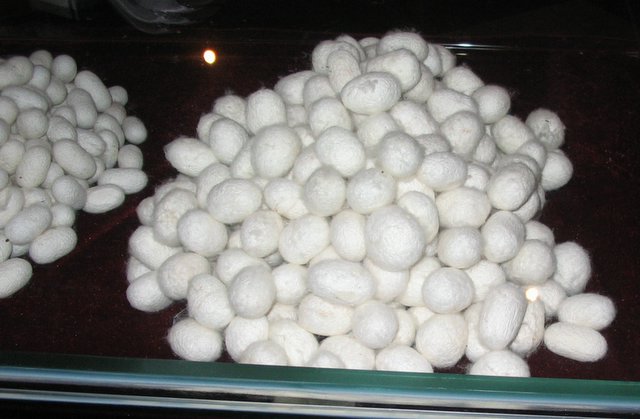
 These puffy white balls are silkworm cocoons. Inside are a male and female silkworm who have been spinning this cocoon for about 10 days. Now we come to the mind-boggling part. Each cocoon contains about 3,000 feet of silk thread. In the silk factory we visited in Suzhou (southern China) workers boil the cocoons to loosen a single thread. They gather together single threads from 8 cocoons and spin them together to make an 8-strand silk thread. You need 3,000 cocoons to make a pound of silk. Silkworms are considered domesticated because they can no longer fly. Only a few silkworms are allowed to grow to be moths so that reproduction can occur and the cycle can start all over again. More pictures to follow. Posted by Picasa

Friday, March 17, 2006

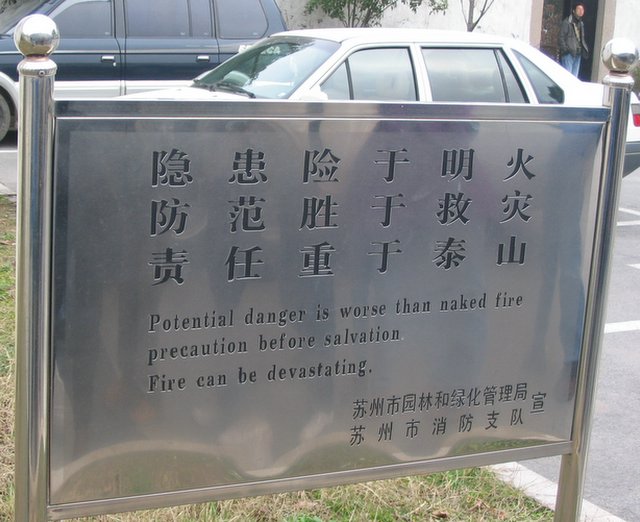
Another Great Sign

 Not sure where we saw this, but I really liked it. Posted by Picasa

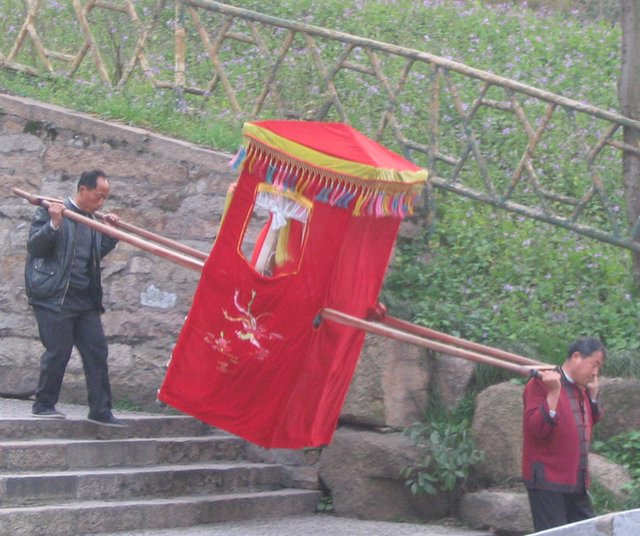
Handicapped Accessibility Is Limited

  This might look funny to you but if you were handicapped and wanted to get to the top of Tiger Hill and see the Leaning Pagoda, this would have been your only way to do it. I don't know how much these gentlemen charged.

The only signs we saw for "handicapped people" were in the bathrooms, and they just denoted western toilets rather than the "squat" ones the Chinese use. But even then there were several steps and narrow doorways to get in and out of the bathroom. We did not see many people in wheelchairs. When we did, it was obvious that they could get out of the chair to get around something that was limiting access. Posted by Picasa

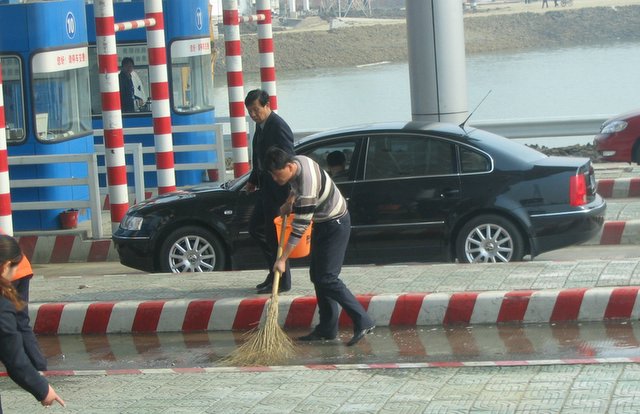
The Ubiquitous Twig Broom

  I like this picture because of the contrast between the new and the old. Brand new car, new toll plaza and the centuries-old broom that is used all over China by government workers and private citizens alike. I guess when you find something that works you stick with it. Posted by Picasa

Chinese Soldier in Tianeman Square

  We are still curious as to why he has two fire extinguishers next to the box he's standing on. He's on the edge of the square. Posted by Picasa

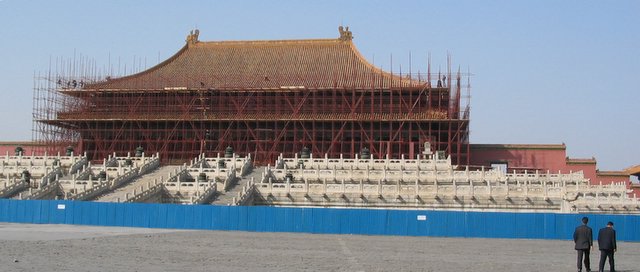
Beijing Hosts 2008 Summer Olympics

 There are signs all over Beijing of the impending Olympics. This is the chance for the Chinese to show the world that they are right up there with the best of them. I've never seen so many construction cranes in one city. Our guide told us that the subway system would go from 35 miles of track to 200 miles. Traffic would come to a standstill if mass transit wasn't expanded. The antiquities are being refurbished including the Emperor's Palace (shown here) in the Forbidden City. It's surrounded by scaffolding and not open to tourists. There is a clock in Tianeman Square that counts down the days, hours and minutes until the Olympics begin in Beijing. All I can say is, I hope they learn how to make a decent Margarita and martini before the torch arrives. Right now their skills are lacking. And they could do with a few softer beds. I also hope the air conditioning works. Beijing is miserably hot and humid in the summer. Posted by Picasa

Big Hunka Jade

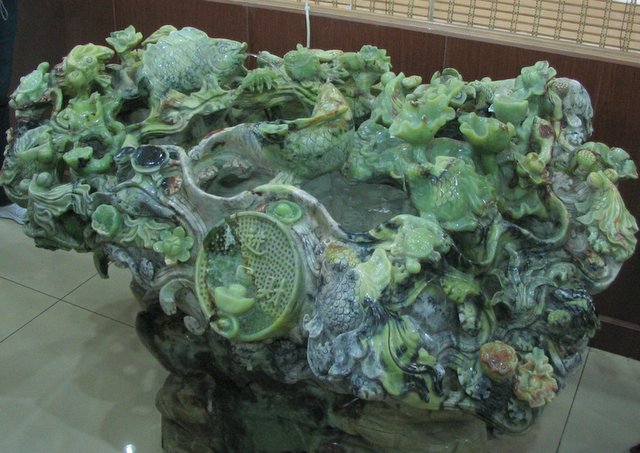
  This jade carving is in the lobby of the jade factory we visited in Beijing. It's carved from one large piece of jade. For some reason, jade has never really interested me. I tried to buy something in the factory store but just never saw anything I liked. That was a rarity in China. Posted by Picasa

Thursday, March 16, 2006

Peking Ducks

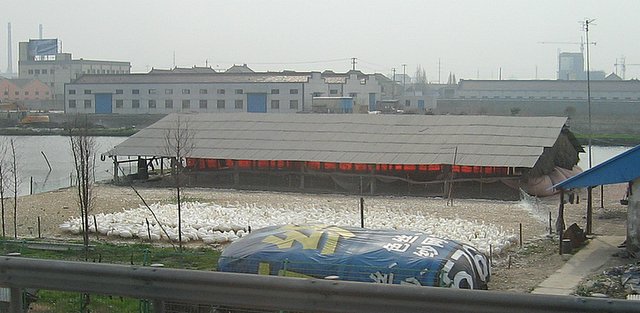
 Those white feathery creatures in the middle of the picture will grow up to be Peking Duck. It's one of the few dishes I recognized in China from my Chinese eating experiences in the U.S. It was just as fatty in China as it is here in the U.S. The crispy skin, however, is delicious. Posted by Picasa

Weddings

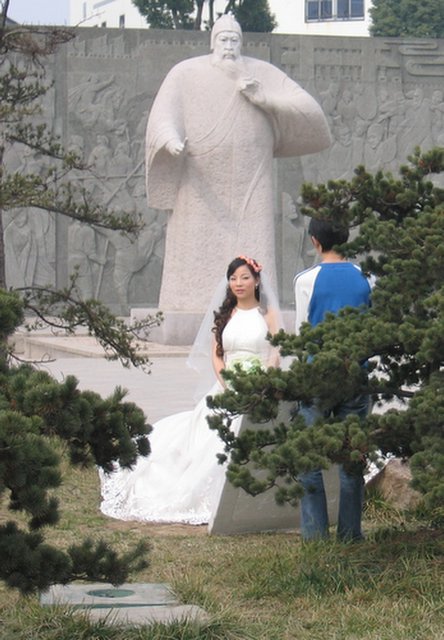
 We saw several couples having wedding pictures taken when we got off the boat after our tour of the Venice of the Orient in Suzhou. The brides rent their dresses plus several other costumes in which to have their pictures taken. This is all done in advance of the actual wedding. It was pretty cold that day. When they were moving from pose to pose, you could see that most of the brides wore long underwear and warm shoes. Posted by Picasa

The Leaning Pagoda Of Suzhou

 Long before the Leaning Tower of Pisa even thought about leaning, this pagoda at Tiger Hill in Suzhou had been built and started to lean. Apparently it has stabilized so no engineering work needs to be done on it. Now the Chinese take great pride in their long history. That wasn't so during the Cultural Revolution. They are quick to point out the short length of U.S. and European history. Afterall, they built the leaning pagoda before Columbus even set sail for America. Posted by Picasa

Excercise


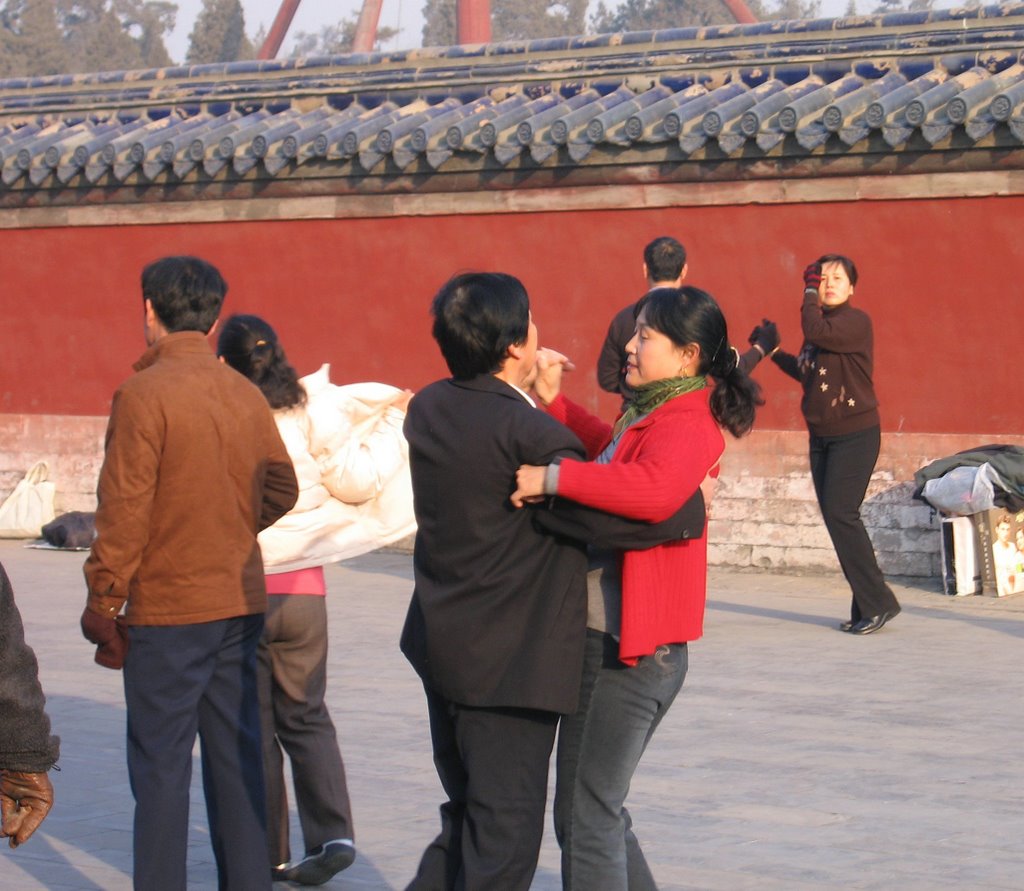
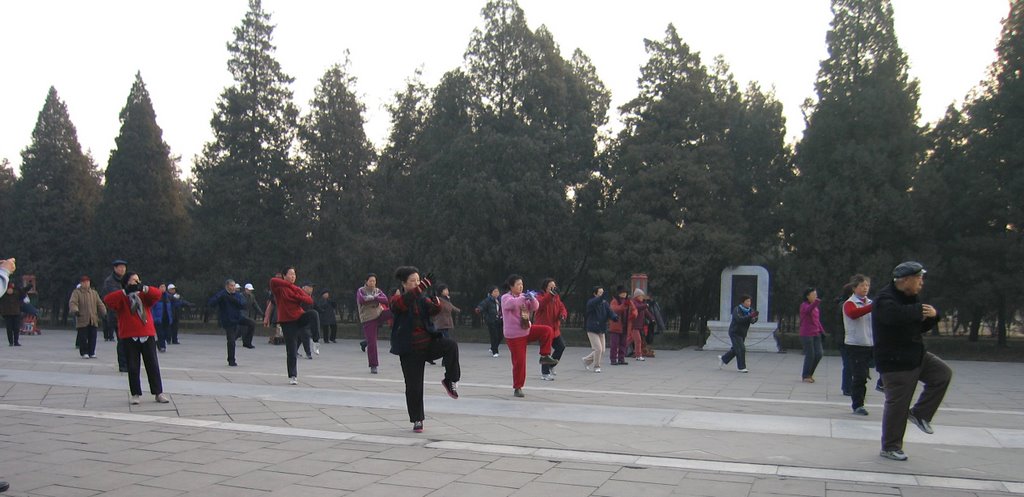
The Tai Chi photo was taken in the Temple of Heaven park in Beijing. This was a common site in parks wherever we went. The Chinese take their exercise seriously. We saw elderly woman out walking who were also moving their arms to get their heart rates up. Playgrounds had equipment that you might find in a gym only it was built to last forever. We saw lots of adults using them. And then the dancing. Well, you just can't find better exercise. Again, the photo was taken in the Temple of Heaven park. The music sounded like a polka, but I don't think it was. Some of the dancers were quite good. With limited space in their homes, when you want to dance or exercise you go outdoors.

Random Thoughts On China

1. Air quality is terrible in most places. Our guide kept assuring us that it was just fog and haze. Meanwhile I had to put on my surgical mask that has a charcoal filter so I could breathe. My throat actually burned before I put on the mask. There are few if any air pollution laws. It's especially bad when you sit in traffic surrounded by diesel trucks. Smoke pouring from stacks was dark gray to black. Between the cigarette smoking and the air pollution they probably have a high incidence of lung cancer and chronic obstructive pulmonary disease (COPD).
2. Water quality is iffy. In Beijing we were told that by 2008 the water will be okay for Americans to drink. Right now it works for the Chinese whose bodies can handle (supposedly) whatever is in the water. We drank bottled water or beer to stay healthy.
3. The taller Chinese live in the south of China. That's where Yao Ming comes from. He's a hero to the Chinese people. His picture is everywhere on billboards. Speaking of billboards, they have some of the biggest I've ever seen. Some stretch for nearly a block.
4. Our guide in Beijing, Ann, said that the Cultural Revolution was a bad thing and that the government was wrong to do what it did in Tianeman Square. She was a teacher at the time. One of her students was shot while standing on the sidelines watching the slaughter. She was a government guide so what she told us must be the government line.
4. The Chinese apparently like very hard beds. The first hotel, which was very modern and nice, had beds that felt like plywood with a thin layer of cottom over them. Not very comfortable but we were so tired it really didn't matter.
5. Our Beijing hotel, King Wing, was listed on the internet as a five-star hotel, which it seemed to be with one exception. The bar was a disappointment. My friend Susan and I said we should set up a consulting business to teach the Chinese how to set up a bar so they will make more money during the Olympics. After a couple days of beer, I decided to order a real drink at the King Wing. The menu listed all the liquors and a bunch of mixes. I asked for Bacardi rum and diet coke with no ice. The young woman waiting on me said, "moment please" and disappeared. She came out of the back room with a young man. They looked at the menu, conferred for a minute and then both disappeared. About ten minutes later my drink arrived with ice and regular coke, but it did have rum. Another couple ordered margaritas, which were on the menu. They came in martini glasses. After that night we went back to beer. The bars were better in the hotels in Suzhou, Hangzhou and Shanghai, but the slow service in all of them certainly cut into their revenue from alcohol.
6. Chinese wine and beer were the only alcohol served on the China Air flights we were on. The vineyard is Great Wall, and it's a consortium of a Chinese company and a French vintner. Let's hope it gets better over time. I could have removed nail polish with the stuff I tasted.
More musings later....
Chinatown in China

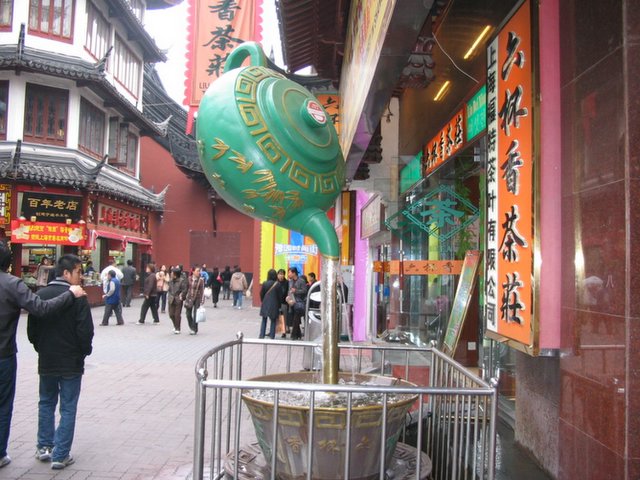
 Our last day in Shanghai was spent in and around the Chinatown area. Lots and lots of little shops selling just about everything both real and fake. Also, quite a few pickpockets. I wore my money, passport, ID and credit cards in a small pouch that hung around my neck under my clothes.

This tea shop was where we found a special clear plastic tea thermos for Kerry so he can take green tea to school with him. He fills it with leaves and hot water in the morning and then just keeps refilling with hot water. You can refill 3-4 times before you need to add more leaves. By that time he is home again. More about green tea later. Posted by Picasa

Wednesday, March 15, 2006

Another Great Sign

 This was on the bar at the restaurant where we ate dinner our last night in Shanghai. It's pretty self-explanatory. Posted by Picasa

Traffic Alerts In Shanghai

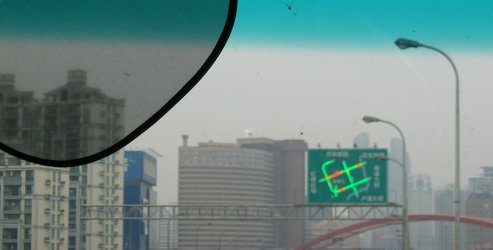
  The green and red diagram in the middle of the picture is the traffic alert system in Shanghai for major roadways. Green means traffic is moving along smoothly. Red means there is congestion. Pretty neat system. Shanghai is considered to be more modern than Beijing. The picture was taken from our bus. Posted by Picasa

Nixon In China...They Still Like Him

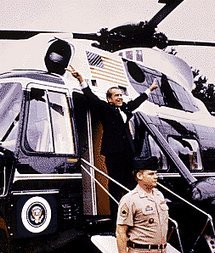
 Some of you may remember the famous Nixon pose with his arms outstretched and his fingers on both hands forming the "V" for victory symbol. One day in Beijing some students noticed that we were Americans and they raised their hands just like Nixon and gave us the victory symbol. We were stunned. Our guide explained that people in China really like Nixon, because he opened up relations with China which started them on the road to where they are today. We were also told that they don't like George W. So it's can't be a Republican thing. I guess George hasn't done anything for them lately. Just a guess. Posted by Picasa

A Rainbow Of Colors For Silk Thread

  Silk thread of all colors was displayed on the shelves in the work area at the carpet factory. I just liked the look of them. Posted by Picasa

One Of The Rugs We Bought

  Those are my feet to the right in the picture. Shortly after they rolled the rug up for our purchase, I spilled part of a can of beer on the floor. Luckily I didn't hit any rugs. One of the sales staff had been sent out to get the beer because they were told that our bus really like beer. They wanted us to be happy while we shopped. I was. The bright white area on the bottom left side of the rug is the flash bouncing off the nap of the rug. Posted by Picasa

Cleaning The River In Shanghai

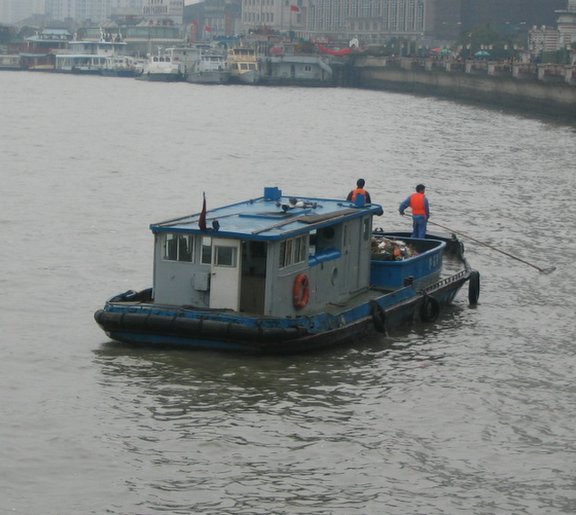
 We rarely saw litter along any roadways whether we were in the cities or countryside. It's one way to employ lots of people. Give them a broom and let them sweep. In this photo the men on the boat are cleaning up the debris floating in the river in downtown Shanghai. Posted by Picasa

Laboring Hard in China To Make Beautiful Things

  There were times during our trip that I was very uncomfortable watching the Chinese workers do their jobs. For example, the young woman at the bottom of this photo is weaving a silk rug in a government-owned factory in Shanghai. She works just outside the showroom where rugs are for sale. Judging by the number of rugs for sale, there are other factories elsewhere in the country in which young women just like this one work under similar or perhaps worse conditions. She is following the rug pattern just above where she is working. The numbers on the pattern denote the color of silk thread. The factory uses vegetable dyes so the rugs will last longer. This young woman will tie 625 knots per square inch on every inch of this carpet. The carpet is 4'x6'. It will take her 20 months to finish. The lighting was not good nor did she have a good place to sit. I saw the same thing in the silk factory earlier in the trip. I'll talk about that with those photos. We did buy two silk rugs for a total of $3,200. The young women who make these beautiful things probably don't get any part of that price. I do love the rugs which arrived today. Posted by Picasa

Monday, March 13, 2006

Traffic and Cell Phones in Beijing

 This is one of my favorite traffic photos. Notice the guy on the left talking on his cell phone as well as the guy peddling the cart that is loaded down with cardboard for recycling. Imagine traffic where bike, car, truck and cart driver are on their cell phones. It gets pretty crazy. Posted by Picasa

Freshwater Pearls

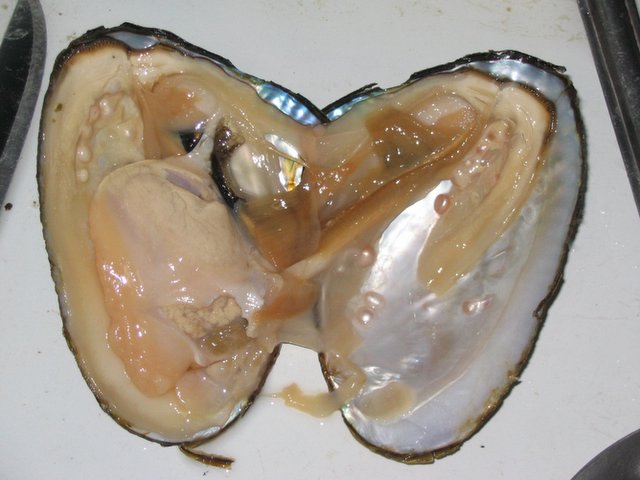
  You may have to click on the picture to make it large enough to see the pink pearls. The Chinese grow freshwater pearls in large oysters that are not edible. The oysters are opened, tiny bits of membrane from another oyster are placed around the inside of the shell and then the shells are tied closed and put back in freshwater. The longer the oyster is in the water the better and bigger the pearls. They get white, black and pink pearls this way. Once we saw the demonstration we were led into a large salesroom filled with all kinds of pearls. Just another opportunity to buy, buy, buy. We had to buy an extra suitcase to get all our stuff home. It was very cheap and broke as soon as we got to our house. Posted by Picasa

Sunday, March 12, 2006

Dogs in China

 I couldn't believe my eyes when I saw this Golden Retriever in a Beijing alley. It was near where we had dinner with the family. He was a big golden and very well taken care of. You could tell he is groomed and brushed on a regular basis. Most of the dogs we saw were mutts, pekingese, or llasa apso. We did see one German Shepherd. Cats were few and far between. They probably do a better job of hiding. Yes, the Golden only understood Chinese. Posted by Picasa

The Rolex Salesman

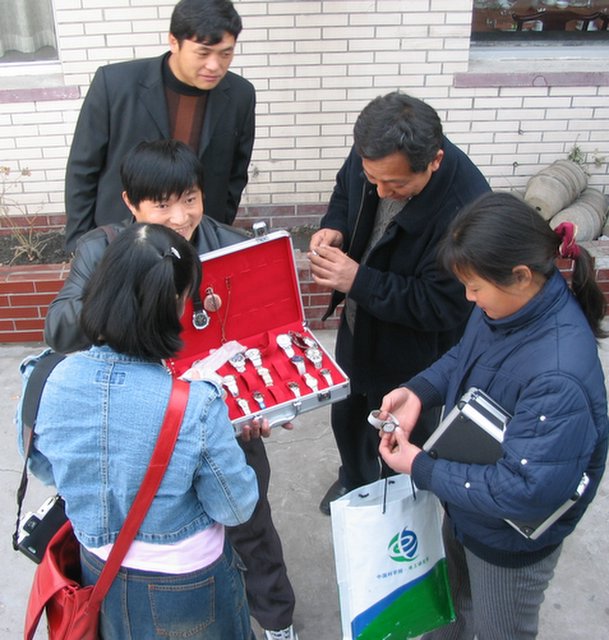
 We were surrounded by peddlers every time we got off the bus. Rolex and Mao watch peddlers abounded. Other items being sold included: paper parasols, postcards, chopsticks, purses of all styles and designers, silk scarves, maps of China (actually quite useful because it was in English). Everything was "besta quality". You always bargain. All transactions are in American dollars. That's what these folks want. I'm sure they report to some cigarette-smoking big boss who takes a healthy cut of what they make. The bargaining was lots of fun. Even when you walked away without buying, the peddler would chase after you offering a better price or more merchandise for the original price. The man on the right is Tom, our bus driver in Beijing. Even Tom bought a faux Rolex. He also kept us supplied in bottled water and TsingTao. The price was two for a dollar. That means two beers or two waters for $1. A lot of beer was consumed on our bus. Tom always had a case open for us. The bus driver in Shanghai, Mr. Whang, didn't quite get it. He bought a six-pack and charged $1 per beer. He bought Sapporo, which wasn't too bad. Naturally Tom got a bigger trip when we left him at the Beijing airport to fly to Shanghai. Posted by Picasa

The Great Wall and a Touristy Photo

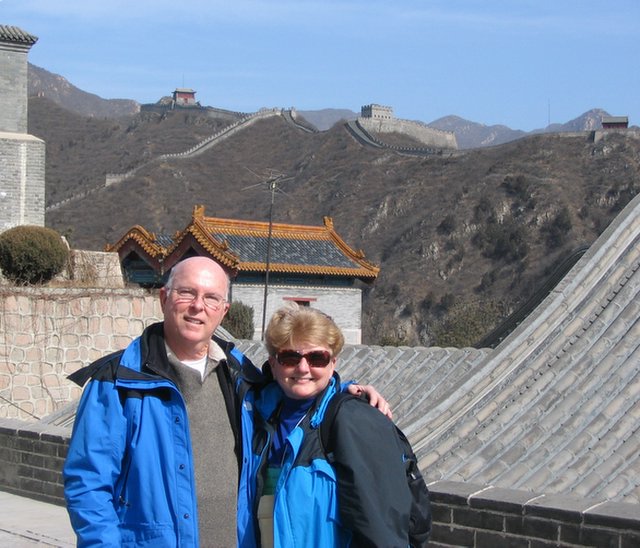
 I think this is the only picture of us standing in front of something famous and touristy. The Great Wall, however, is amazing. It's 4,000 miles long and was built more than 2,000 years ago by the first emperor of China, Chin. Once he had unified China's provinces into one country, he wanted to keep the Mongolian hordes out it. He thought the wall would do it. Supposedly you can see the Great Wall from the moon. At least that's what the astronauts reported. Much of the wall is crumbling, but this portion outside of Beijing has been rebuilt for the tourists. Posted by Picasa

Starbucks In The Forbidden City

 Yes, the Chinese government allowed Starbucks to open a tiny store in the Forbidden City. There are 49 Starbucks in Beijing and 57 in Shanghai. A Starbucks was the first thing we saw when we came through immigration at Beijing Airport. KFC was right next door to it. For a minute I thought we hadn't left San Francisco yet. Posted by Picasa